✨ Summarize article with AI

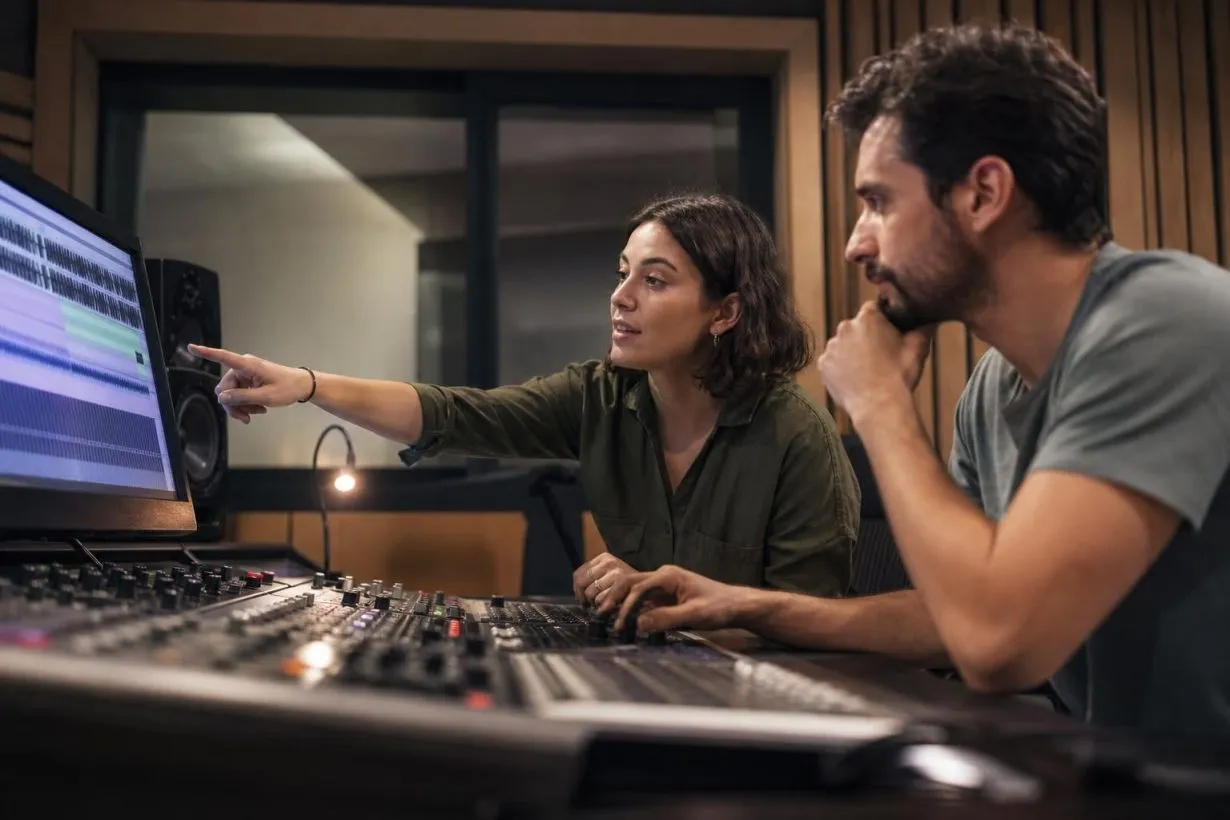
Music makes TV adverts measurably more effective across creativity, empathy, and emotional impact. But sourcing the best TV advert music means navigating confusing terms like sync licenses, master licenses, PROs, and royalty-free misconceptions. This glossary defines every term you’ll encounter, explains what each one actually costs, and walks you through a practical checklist for choosing broadcast-ready music without legal headaches.
You’ve been told to “find music for the TV spot,” and now you’re staring at terms like sync license, master use, PRO clearance, and needle drop, wondering if they were invented specifically to confuse you. This glossary is for marketers and agency producers who need clear answers, not legal jargon. By the end, you’ll understand every term in the TV advert music process and know exactly how to source tracks without overpaying or getting caught in a licensing trap.
Music isn’t decoration. It’s one of the most measurable performance drivers in television advertising.
A Nielsen study of more than 600 TV advertisements found that commercials with music performed better across four key metrics: creativity, empathy, emotive power, and information power. That’s not a marginal improvement across one dimension. Music lifted every metric they measured.
The industry has clearly internalized this. Research from Zappi shows that 86% of ads now contain at least some level of music. And a 2026 Sound Research Institute study of 8,400 radio listeners across 12 U.S. markets found that ads with original music composition saw 68% higher attention retention.
But here’s the counterpoint that sharpens the case for TV specifically. Kantar research found that roughly 85% of Facebook viewing happens with the sound off, even though 50% of Facebook ads contain music. That makes the expense of music rights harder to justify on social platforms where nobody hears it. TV is where music earns its keep, because the sound is on.
Browse broadcast-ready tracks with lifetime licenses and no recurring fees.
Understanding what kind of music you’re working with determines everything downstream: cost, licensing complexity, and creative control. Here are the six categories you’ll encounter when sourcing the best TV advert music.
A jingle is a short, catchy song written specifically for an advert. It contains hooks and lyrics that explicitly promote the product or brand, often built around a slogan. Think of the McDonald’s “I’m Lovin’ It” melody or the Intel chime (though that one’s technically a sonic logo).
Jingles cost more upfront than any other option, typically $5,000 to $500,000 depending on production scope and talent. But because the brand owns the composition outright, there are no recurring licensing fees. For brands running multi-decade campaigns, original jingles deliver the best long-run cost-per-impression of any music type.
Worth noting: the jingle fell out of fashion in the 2000s as marketers discovered that licensing popular songs with built-in earworms could generate instant emotional association. But jingles are quietly making a comeback as brands seek distinctive sonic identities they fully control.
This means placing an existing, well-known song in your advert. When a car brand uses a Fleetwood Mac track or a phone commercial features a trending artist, that’s a licensed popular track.
The upside is immediate recognition and emotional resonance. The downsides are cost and risk. Licensing fees for popular tracks range from $50,000 to $2 million or more. Practitioners on forums like Sound Imagination report that even regional clients have paid sync license fees between $20,000 and $90,000 for just one year’s use, and that only covers the composition rights, not the master recording.
There’s also reputational risk. If the artist gets embroiled in controversy after your campaign launches, your brand is along for the ride.
Production music (also called library music or stock music) is pre-recorded music created specifically for licensing in film, television, radio, and advertising. Unlike popular music publishers who might own less than 50% of a composition’s copyright, production music libraries typically own 100% of the rights because the music is created on a work-for-hire basis.
This matters enormously for advertisers. Full ownership by the library means simpler licensing, faster clearance, and no third-party conflicts. Foximusic, for example, owns 100% of its catalog in-house, which eliminates the scenario where a composer or third-party publisher pulls rights mid-campaign.
For a deeper look at how instrumental music works for advertising, that guide covers genre selection and mood matching.
A sonic logo is a 3-to-5-second branded audio mark. Netflix’s “ta-dum,” the HBO static, the T-Mobile jingle, these are all sonic logos. They function as the audio equivalent of a visual logo.
Production costs are lower than a full jingle, and sonic logos are extremely versatile. They work across TV spots, podcast pre-rolls, app notifications, and social media. For brands building a consistent identity across platforms, a sonic logo is often the most efficient investment.
An original score is custom music composed specifically for your advert, but unlike a jingle, it doesn’t contain brand-specific lyrics or slogans. It’s instrumental or ambient music tailored to the ad’s narrative arc, pacing, and emotional targets.
Original scores give you complete creative control and exclusivity. No competitor will ever use the same track. The cost varies widely ($3,000 to $100,000+) depending on whether you’re hiring a solo composer or a full orchestral session.
Needle drop is industry shorthand for selecting a pre-existing track and “dropping” it into your advert. There’s no composition work involved, just selection and licensing. This is how most library music and royalty-free tracks get used.
The term dates back to the vinyl era, when a producer would literally drop a turntable needle onto a record. Today it describes the most common workflow for finding the best TV advert music quickly and within budget.
This is where most marketers get lost. Licensing terminology is scattered across dozens of sources, and no two platforms define terms the same way. Here’s what each term actually means when you’re producing a TV advert.
For a broader overview, this guide to music license types explained covers the full spectrum.
A sync license gives you legal permission to pair copyrighted music with visual content. The word “synchronization” literally describes the synced pairing of audio and visuals.
Here’s what trips people up: there are actually two sync licenses required. One covers the song itself (the composition), obtained from the publisher or songwriter. The other covers the specific recording (the master), obtained from whoever owns that recording, usually a label. If you want to use Aretha Franklin’s version of “Respect,” you need a sync license for the Otis Redding composition and a master license for Aretha’s recording.
For a detailed breakdown, see what is a sync license and how it applies to advertising.
The master license grants permission to use a specific recording of a song. The label or artist who funded the recording session typically owns the master. This is separate from the composition rights and often costs as much or more than the sync license.
When you use library music or production music where the library owns both the composition and the master, you skip this entire two-license dance. That’s one of the primary reasons production music exists.
This is the most misunderstood term in the industry. The word “free” has nothing to do with price. Royalty-free means you pay a one-time upfront fee (or subscription), and no per-use royalties are generated after that. You still pay for the music. You still need to read what the license actually covers.
The critical nuance for TV adverts: not all royalty-free licenses cover broadcast. Some cover personal use only. Some cover social media but not television. Practitioners on Reddit’s r/editors community specifically warn against assuming subscription licenses cover broadcast use, recommending per-track or per-project licensing for commercial work instead.
Before licensing any royalty-free track for television, confirm the license tier explicitly includes broadcast/TV rights. If you’re comparing one-time payment vs. subscription licensing models, that distinction matters more for broadcast than any other use case.
A blanket license comes from a PRO (more on that below) and covers the public performance of all songs in that PRO’s catalog. Most TV and radio broadcasters already hold blanket licenses.
The key distinction: a blanket license covers airing music, not pairing it with visuals. You still need a sync license to put a song in your advert. The blanket license just means the broadcaster can air the finished product without additional performance royalty issues. Understanding this distinction prevents one of the most common legal mistakes in TV advert music sourcing.
A Performing Rights Organization collects performance royalties when its members’ music is played publicly, including on television and radio broadcasts. In the U.S., ASCAP, BMI, and SESAC are the major PROs. In the UK, it’s PRS for Music.
For most advertisers, here’s the practical reality: most broadcasters already hold blanket performance licenses from these PROs, so you typically don’t need to obtain a separate performance license yourself. But the paperwork and cue sheets still add friction.
PRO-free music eliminates this entirely. When the catalog isn’t registered with any PRO, there are no performance royalty obligations, no cue sheets to file, and no surprise fees. Foximusic’s catalog is PRO-free, which simplifies the broadcast workflow considerably. For a detailed walkthrough, see TV broadcast music without the PRO headache.
MFN is a deal structure where the sync fee for the master recording and the sync fee for the composition must be equal. If you negotiate $30,000 for the master, the publisher gets $30,000 too. An “all-in” sync fee covers both, split evenly.
This term mostly comes up when licensing popular tracks. With library music where a single entity owns both the master and the composition, MFN is irrelevant because there’s no split to negotiate.
A legal designation where the copyright belongs to the employer, not the person who actually created the work. In advertising, this applies most often to jingle writers and composers hired to create bespoke music for campaigns. The advertiser or agency owns the resulting composition outright.
This is also the basis of most production music libraries. Composers create tracks under work-for-hire agreements, so the library owns 100% of the rights and can license them without needing the composer’s permission for each deal.
A buyout means you pay once and own (or have the right to use) the music forever. No renewal dates, no recurring fees. The term “perpetual license” is more precise: you don’t own the copyright itself, but your license to use it never expires.
Need broadcast-cleared music without PRO paperwork? Foximusic’s Extended license covers TV, radio, VOD, streaming, apps, games, courses, and film/festivals under a single lifetime license at fixed per-track pricing.
A music supervisor oversees all music-related aspects of a production. In advertising, the music supervisor works for (or is hired by) the agency. They find tracks, negotiate licensing deals, manage budgets, and ensure every piece of music is properly cleared.
According to the Guild of Music Supervisors, they act as a liaison between clients and rights holders, working to arrange appropriate licensing agreements that come in on budget. For large campaigns with multiple placements, a music supervisor is essential. For smaller productions using library music, the process is simple enough that an in-house producer can handle it.
The entity that owns or administers the rights to a musical composition (the song itself, not the recording). Publishers handle sync licensing negotiations, collect royalties, and manage the catalog. When you license a popular track, the publisher is one of the two parties you negotiate with.
A general term for whoever owns the copyright to a piece of music. This could be the artist, a label, a publisher, or a production music library. Identifying the rights holder is always step one in any licensing negotiation.
Marketers are tapping into micro-genres like lofi hip-hop, synthwave, and Afrobeat to reach specific audiences. These sounds make ads feel fresh and culturally relevant rather than generic. A fintech brand targeting Gen Z might use lofi beats. A luxury travel brand might use ambient electronica. The days of defaulting to upbeat indie-pop for every campaign are fading.
Classic rock and pop songs from past decades are returning to TV advertising. Brands use the familiarity of these tracks to trigger emotional memories and build instant trust. The trade-off is cost: licensing a well-known catalog track for a national campaign averages around $30,000 for sync alone, and global campaigns can run $100,000 to $250,000 or more, according to industry fee benchmarks.
Electronic and hip-hop music are increasingly used to inject energy and edge into campaigns. These genres skew younger and work well for tech, automotive, and lifestyle brands.
The best TV advert music now needs to work beyond the 30-second spot. It has to flow from TV to TikTok to YouTube to podcast sponsorships. This is driving demand for tracks available in multiple edits (full, loop, and short versions) that maintain brand consistency across every touchpoint.
For guidance on repurposing advert music for social platforms, that resource covers the specific requirements for Facebook and Instagram.
AI music tools can generate decent background tracks, but for broadcast TV adverts, human-composed music remains the standard. The emotional nuance, cultural awareness, and brand-specific tailoring that a human composer or curated library provides is difficult for AI to replicate at broadcast quality. Most agencies still want a human hand on the music for their biggest campaigns.
Pulling together everything in this glossary, here are the concrete steps for sourcing the best TV advert music for your campaign.
1. Define your ad’s emotional tone first.
Before browsing any catalog, write down three words that describe the feeling you want. Hopeful and warm? Urgent and edgy? Nostalgic and bittersweet? This prevents the most common time-sink: browsing thousands of tracks with no filter.
2. Confirm the license tier covers broadcast.
Not every “royalty-free” or “commercial” license includes TV rights. Look for explicit broadcast/TV coverage in the license terms. An interesting insight from the Gearspace forum: music in a TV commercial airs far more frequently than music within a TV show episode, so the licensing structure accounts for that volume. Make sure your license does too.
3. Check PRO status (or choose PRO-free).
If the music is registered with a PRO, your broadcaster may need blanket licenses, and cue sheets will be required. PRO-free music eliminates these steps entirely.
4. Get multiple edits for different cut lengths.
A 60-second version, a 30-second version, a 15-second cutdown, and a loop for extended sequences. Tracks that come with full, loop, and short edits save hours in post-production.
5. Secure perpetual rights to avoid renewal costs.
Campaigns get extended. Spots get re-aired for award submissions. Old ads resurface on YouTube compilations. A perpetual license means you never have to worry about expiration dates. This guide on how long a music license lasts explains why duration matters more than most marketers realize.
6. Test across platforms before committing.
Will this track work on TV, on Instagram (where it might play without sound initially), in a YouTube pre-roll, and as a podcast mention? Cross-platform testing before final selection saves expensive re-licensing later.
7. Document everything.
Keep your license certificates, invoices, and correspondence organized. If a broadcast network or platform flags your content, you need proof of clearance within hours, not days.
Looking for broadcast-ready tracks with lifetime rights and no PRO complications? Start with these Foximusic playlists curated by mood and genre for advertising.
Research consistently shows that music works best when it drives the action of the ad rather than just sitting in the background. A Neurosight study of over 150 ads found that when lyrics, tempo, or mood match what’s happening on screen (a concept called emotional congruence), long-term memory encoding increases significantly.
Yes, if the license explicitly covers broadcast use. “Royalty-free” only means you don’t pay per-use royalties after the initial purchase. It says nothing about the quality of the music or whether TV rights are included. Always verify the license tier before airing anything.
It depends entirely on the source. A popular track for a national U.S. campaign averages around $30,000 in sync fees alone, and global campaigns can exceed $250,000. Library music with broadcast rights can cost as little as $100 to $150 per track. For a detailed cost breakdown by use case, see how much does a song license cost.
If you’re licensing a pre-existing recording (like a popular song), yes. You need one license for the composition from the publisher and another for the recording from the label. If you’re using production music from a library that owns both rights, a single license typically covers everything.
PRO-free means the music isn’t registered with any Performing Rights Organization (ASCAP, BMI, SESAC, PRS, etc.). This eliminates the need for blanket performance licenses, cue sheets, and potential surprise royalty obligations. For TV advertisers, it simplifies the entire broadcast clearance workflow.
That depends on your license. Some licenses cover broadcast but not digital, and vice versa. The safest approach is choosing a license that explicitly covers both TV and online platforms, or selecting Content ID-cleared music to avoid automated takedowns on YouTube and social channels.
For large campaigns with six-figure budgets and multiple placements, a music supervisor saves time and money through better negotiations and proper clearance management. For smaller campaigns using library or royalty-free music, an experienced producer can usually handle the selection and licensing directly.
Confirm that your music license covers digital and social media use in addition to broadcast. Choose tracks from catalogs that are Content ID-cleared so platforms like YouTube won’t flag or mute your content. And keep your license documentation accessible for disputes.
Generate production-ready text-to-video prompts instantly and get pro-level results with our free video prompt generator tool.







 English English
  Spanish
 French
 Italian
 German
 Portuguese
 Chinese
 Japanese
 Hebrew