✨ Summarize article with AI

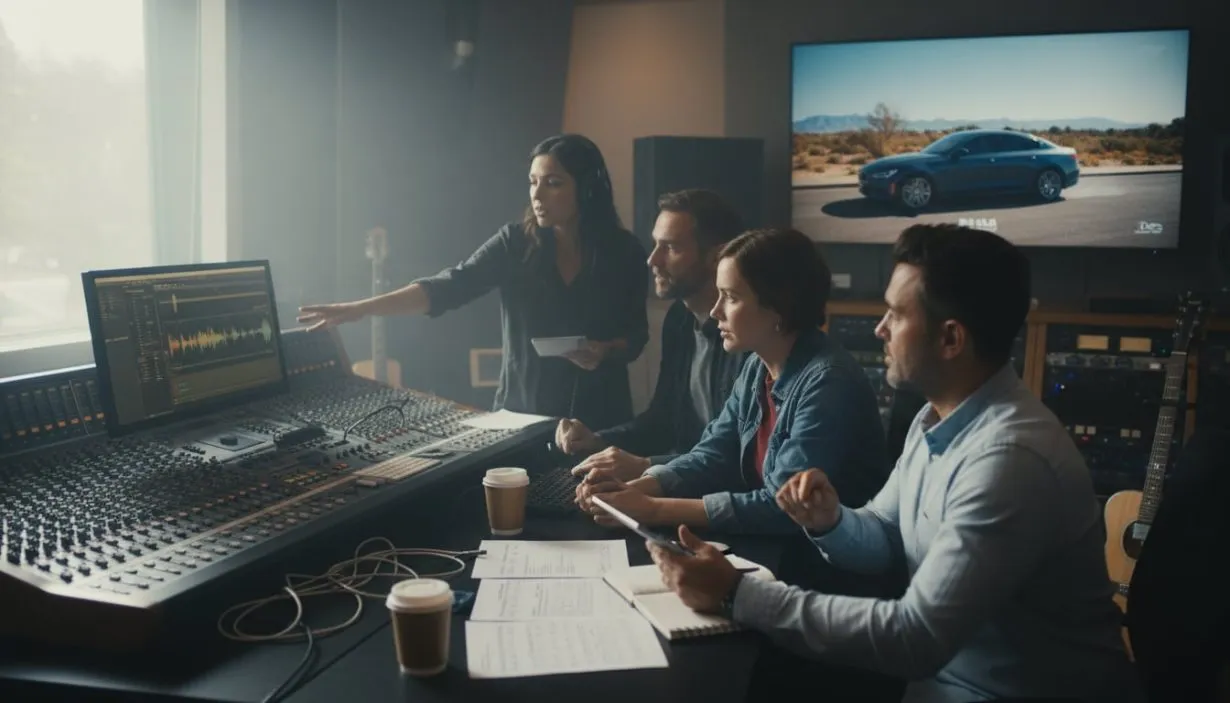
A sync license (synchronization license) is permission to pair copyrighted music with visual media like videos, films, ads, games, and apps. It covers the song composition, not necessarily the specific recording, which may require a separate master license. Most creators and businesses can skip complex negotiations by using pre-cleared royalty-free music that already includes the rights they need.
This article is educational and does not constitute legal advice.
A sync license, short for synchronization license, gives you permission to use a copyrighted musical composition together with visual media. The word “sync” refers to synchronizing music with images. Any time you place a song underneath, alongside, or within a visual project, you are creating a synchronized audiovisual work.
This applies whether the music is a background bed, a featured element, a theme, or a brief transition cue. It does not matter if the video is 10 seconds or two hours. Yale’s rights-clearance guide defines synchronization rights as the right to combine musical works “in timed relation with images or other visual works” source. Easy Song’s help center puts it more simply: a sync license is required whenever copyrighted music is paired with visual media source.
Here is a quick example. You create a product demo video and drop a 30-second music bed behind it. You have now synchronized that music with your visuals. If you do not own the music or have permission, you have a licensing problem.
Music copyright is not one single right. It is a bundle of rights, and different uses trigger different permissions. The reason sync licensing exists as a separate category is that attaching music to visuals creates something new: an audiovisual work. That is a fundamentally different use from simply playing a song on a speaker or distributing an audio file.
Making things more complicated, a single piece of music often involves two separate copyrights:
The musical composition (the melody, lyrics, and arrangement, owned by the songwriter or publisher)
The sound recording (the specific recorded performance, owned by the artist, producer, or label)
The U.S. Copyright Office explains that musical works and sound recordings are separate copyrightable works, commonly owned and licensed separately source. This distinction matters because clearing one does not automatically clear the other.
Understanding the different types of music licenses is the first step toward avoiding legal trouble.
You typically need a synchronization license when three conditions are true:
The music is copyrighted (someone else owns it).
The music is paired with visuals.
The final project will be shared, published, distributed, sold, or shown to an audience.
That covers a wide range of projects:
YouTube videos
TikTok, Instagram Reels, and Facebook videos
Paid digital ads and social media ads
Corporate and product videos
Film and documentary scenes
TV commercials and broadcast content
Trailers and promotional clips
Video games
Mobile apps with visual interfaces
Online courses and video lessons
Video podcasts
Livestream graphics and “starting soon” screens
VOD and streaming content
Track Club lists films, TV shows, commercials, online videos, and other audiovisual projects as standard sync-license use cases. If your project has visuals and uses someone else’s music, the question is not whether you need permission but what kind of permission you need.
For YouTubers specifically, the stakes are immediate. A Content ID claim can affect your revenue within hours. If you are building a channel, choosing royalty-free music designed for YouTube creators removes that anxiety from the start.
Sync licenses are not one-size-fits-all. The scope varies dramatically depending on who grants the license, how it is structured, and what terms are included. A good sync license should clearly answer these questions:
Which track? Title, composer, publisher, recording owner.
Which project? The specific video, film, ad, game, app, or course.
Which platforms? YouTube, social media, web, TV, cinema, VOD, apps, games.
Commercial or personal? Whether monetization, client work, and advertising are permitted.
Territory? Country-specific or worldwide.
Term? Limited duration or perpetual.
Exclusivity? Whether others can license the same track.
Edits allowed? Loops, cuts, stems, duration limits.
Attribution? Whether credit is required.
Transfer rights? Whether the license can cover client projects.
Content ID process? What proof to provide if a platform flags the video.
Musicbed notes that sync license cost and complexity vary significantly by project scale, and traditional sync licensing often involves complex negotiation around these exact terms. Before you publish anything, you can review Foximusic’s music license agreement to see what clearly defined terms look like in practice.
This is where most creators get tripped up. A sync license on its own may not solve every rights issue.
It may not cover the master recording. If you want to use a specific existing recording (say, the original studio version of a hit song), you usually need a master use license from the recording owner in addition to the sync license for the composition.
It may not cover public performance obligations. If your video is broadcast on TV or played in a public venue, there may be separate public performance licensing requirements handled through performing rights organizations.
It may not cover every platform or commercial use. A sync license negotiated for a YouTube video does not automatically extend to TV broadcast, apps, games, paid ads, or courses unless those uses are explicitly included.
It does not mean you own the song. You have permission to use it under specific terms. You cannot resell, redistribute, or sublicense the music itself.
It does not guarantee zero automated claims. Even with a valid license, YouTube’s Content ID system may generate an automated claim. The license gives you proof to dispute that claim, but the claim itself is triggered by audio fingerprinting, not legal analysis.
Think of music rights as a stack. Each layer represents a different type of permission. A sync license is one layer. Depending on your project, you might need several.
If you are using… | You may need… | Why |
|---|---|---|
A copyrighted song in a video | Sync license | Permission to pair the composition with visuals |
A specific existing recording | Sync license + master use license | The composition and recording are separate copyrights |
A cover version in a video | Sync license for the composition | New recording avoids the original master, but the song itself still needs clearance |
Audio-only cover distribution | Mechanical license (not sync) | Mechanical covers audio reproduction, not audiovisual use |
Music played publicly or broadcast | Public performance license (possibly in addition) | PROs handle performance rights, not sync rights |
Pre-cleared library music | Platform license with sync-style terms | The license should explicitly grant video/visual use |
The safest question is not just “Do I have a sync license?” but “Does my license cover both the composition and the recording, and does it cover my exact use?”
Practitioners on Reddit echo this. In an r/COPYRIGHT thread, a user asked how to contact rightsholders to license music for video. The top answer explained that you may need a synchronization license from the publisher or composition owner and a separate master use license from the sound recording owner source. For many creators, this two-party clearance process is the exact reason pre-cleared music libraries exist.
A sync license clears the song composition (the melody, lyrics, arrangement) for use with visuals. A master license clears the specific sound recording.
If you want to use the original studio recording of a famous song in your film, you generally need both. The publisher or songwriter grants the sync license. The label or recording owner grants the master license. These are separate negotiations, sometimes with different parties, different fees, and different timelines.
If you record your own cover instead, you can avoid the original master license, but you still need sync permission for the underlying composition unless it is in the public domain.
The Copyright Office makes this distinction clear: musical works and sound recordings are separate works, subject to different rules source.
A mechanical license covers reproducing and distributing a musical composition in audio-only formats. Think cover songs on streaming platforms, CDs, or digital downloads.
A mechanical license does not let you put a cover song in a video. Yale’s rights-clearance guide explains that synchronization rights are separate and not covered by the compulsory mechanical licensing scheme that governs certain audio-only uses source. This is a common and costly mistake. Creators who obtain a mechanical license for a cover assume they can upload a music video. They cannot, at least not without additional sync clearance for the composition.
Public performance licenses cover playing or transmitting music publicly, whether in a restaurant, at a live event, or through a broadcast. These are typically handled by performing rights organizations (PROs) like ASCAP, BMI, and SESAC.
Here is the critical point that trips up thousands of creators every year: a PRO license is not a sync license.
ASCAP’s own guide states plainly that ASCAP does not license the right to record music as part of an audiovisual work. Those synchronization rights are licensed by writers, publishers, or their agents source.
Reddit discussions repeatedly surface this confusion. One r/COPYRIGHT thread noted that YouTube may have blanket PRO arrangements for public performance, but those arrangements do not cover sync or master use rights source. If you need music for a video, contacting ASCAP or BMI will not get you the permission you actually need.
There are three common paths, each suited to different situations.
This is the traditional approach. You identify the publisher or composition owner, and (if using a specific recording) the master owner, then negotiate terms directly.
Best for: Projects that require a specific famous or meaningful song.
Downsides: Slow, uncertain, potentially expensive. Rights holders can set any fee, take weeks to respond, or decline the request entirely. Easy Song’s help center confirms this uncertainty source.
For films, national ads, TV shows, and larger productions, a music supervisor handles research, outreach, negotiation, and paperwork.
Best for: Complex or high-budget projects with multiple cues.
Downsides: Adds cost and does not guarantee approval.
The creator selects music from a catalog where license terms are already set. No negotiation. No waiting. No chasing multiple rights holders.
Best for: YouTubers, agencies, small businesses, app developers, course creators, podcasters, and video editors who need speed and predictable terms.
This is where the concept of “one-stop” rights becomes important. Practitioners on Reddit’s r/synclicensing define “one-stop” as one party controlling or being authorized to represent all needed master and publishing rights source. Another practitioner thread noted that tracks with unclear splits, samples, or complicated ownership create clearance issues, and supervisors will simply move on source.
For creators who do not need a famous song, pre-cleared music eliminates the entire clearance headache. Foximusic, for example, owns 100% of its catalog and offers one-time payment, lifetime licenses with Personal, Commercial, and Extended tiers. That means a single purchase covers both composition and recording rights, with no subscription and no renewal.
Need music that is already cleared for video? Browse Foximusic’s royalty-free catalog and choose the license tier that matches your project.
A micro-sync license is a smaller, more standardized version of a traditional sync license. It is designed for lower-budget and digital-first projects: YouTube videos, indie films, wedding videos, small business content, social ads, and creator work.
Traditional sync licensing involves individual negotiation, custom fees, and often weeks of back-and-forth. Micro-sync licensing strips that down. You pick a track, you see the price, you buy the license, and you are cleared.
Musicbed describes micro sync licenses as cost-effective and suitable for small-scale, budget-conscious projects, while traditional sync licensing tends to be more expensive and individually negotiated.
Model | Best for | Typical process | Key risk |
|---|---|---|---|
Traditional sync | Feature films, national ads, TV, famous songs | Contact publisher/label, negotiate scope and fee | Slow, expensive, possible refusal |
Micro-sync | YouTube, indie films, small business, social content | Buy pre-cleared track under standard terms | Must confirm the license covers your specific use |
Royalty-free license | Creators and businesses needing predictable rights | Pay once or subscribe, use under license terms | “Royalty-free” is often misunderstood as “copyright-free” |
For most online creators and small businesses, the micro-sync or royalty-free path is the practical choice. The savings in time, cost, and legal risk are significant. Platforms offering one-time purchase music licensing make this path even simpler by removing recurring subscription fees.
Not exactly, but there is significant overlap. “Royalty-free” describes a payment model, not a copyright status.
Royalty-free music is still copyrighted. It still comes with license terms. What makes it “royalty-free” is that you do not pay ongoing per-use royalties after the initial license purchase. ThatPitch warns that “royalty-free” does not automatically mean no license is needed source.
Understanding what royalty-free music actually means helps avoid dangerous assumptions. Here is what royalty-free does not mean:
It does not mean no copyright exists.
It does not mean public domain.
It does not mean unlimited use in every project type.
It does not mean you own the music.
Many royalty-free music licenses include sync-style rights for video and visual media. But the scope varies by platform and tier. A personal-use license might cover a non-monetized YouTube video but not a paid ad or a broadcast commercial. Always check the specific terms.
YouTube is the single biggest reason most creators first encounter the term “sync license.” Understanding how Content ID works is essential.
YouTube’s Content ID system scans uploaded videos against a database of reference files submitted by rights holders. When a match is found, the system generates an automated claim. YouTube says Content ID claims can block a video, monetize it by running ads (with revenue going to the rights holder), or simply track viewership source.
The scale is staggering. According to TorrentFreak’s reporting on YouTube’s transparency data, YouTube processed more than 2.2 billion Content ID claims in 2024, with Content ID accounting for 99.43% of all copyright actions on the platform.
A Content ID claim is not the same as a copyright strike. YouTube says claims are automatically generated and usually affect the individual video rather than the channel as a whole. Copyright strikes, by contrast, are the result of formal takedown requests and can lead to channel penalties source. Many creators panic at the first claim, assuming their channel is at risk. Usually, it is not, but the claim can still redirect revenue or limit where the video is available.
If you have a valid license, you can dispute a Content ID claim. YouTube lets creators dispute claims when they are confident they have the necessary rights source. But you need documentation. Keep these on file:
PDF license certificate
Invoice or receipt
Track title and version used
Project URL
License tier and scope
Client name (if applicable)
Claim-dispute instructions from the music provider
Content ID-cleared music reduces the likelihood of claims in the first place. Foximusic’s catalog is Content ID-cleared, and instant PDF license certificates are issued after every purchase. For a deeper look at how this system works, read about YouTube Content ID and AdRev.
Even with Content ID-cleared music, automated claims can occasionally appear. No system is perfect at a scale of 500+ hours of video uploaded every minute. The difference is that with a valid license and proper documentation, resolving a claim is straightforward rather than catastrophic.
A self-identified music supervisor on Reddit shared that they avoid libraries whose licenses use vague language that essentially suggests uncertain rights ownership source. Another practitioner on LinkedIn noted that a track can lose a sync opportunity if a supervisor cannot find full metadata or if the rights holder is slow to deliver alternate versions source.
Watch out for these warning signs:
“Copyright-free” claims with no actual license terms
No named licensor or rights holder
No proof of license after purchase
No clear commercial use terms
No statement about Content ID or claims handling
No clarity on whether both composition and recording rights are included
No policy for client work, paid ads, broadcast, apps, games, or courses
Vague or contradictory scope language
Documentation matters. Practitioners on Reddit’s r/musicbusiness emphasize that licensing companies and supervisors want everything in writing, including split information, legal names, publishing details, and signatures from all parties source.
“Royalty-free means no license.” Wrong. Royalty-free describes the payment structure. The music is still copyrighted and governed by license terms.
“I credited the artist, so I’m covered.” Credit is not permission. A license must grant the use. Attribution is sometimes a license requirement, but it is never a substitute for one.
“I only used 5 seconds.” There is no magic number of seconds that makes unlicensed use safe. The U.S. Copyright Office says there is no formula guaranteeing that a predetermined amount of a work can be used without permission source. YouTube also warns that even brief use of popular music can affect monetization source.
“A mechanical license lets me put a cover song on YouTube.” A mechanical license covers audio-only distribution. Video use requires sync clearance for the composition source.
“ASCAP gave me permission.” ASCAP licenses public performance rights. It does not license synchronization rights for audiovisual works source.
“A Content ID claim means I broke the law.” Not necessarily. Claims are automated and can happen even when you have a valid license. They are different from copyright strikes and usually affect the video, not the channel source.
“This song is public domain, so I can use any recording of it.” The composition and recording are separate copyrights. A public-domain melody does not mean every recording of it is free to use source.
Before you hit publish on any video project with music, verify these points:
[ ] I have permission to use the composition.
[ ] I have permission to use the recording, or my music provider controls both.
[ ] The license covers my project type (video, ad, film, app, game, course).
[ ] The license covers monetization if I earn revenue from the project.
[ ] The license covers client work if I am producing for someone else.
[ ] The license covers paid advertising if I will run the video as an ad.
[ ] The license covers worldwide distribution if the project will be available globally.
[ ] The license is perpetual if I need lifetime use.
[ ] The license covers broadcast, VOD, apps, games, or courses if relevant.
[ ] I saved my license certificate and invoice.
[ ] I know how to respond if a copyright claim appears.
For projects requiring broadcast, app, game, VOD, or course coverage, Foximusic’s Extended License consolidates TV/radio, streaming, apps/games, courses, film/festivals, and large live audiences (up to 20,000) under a single lifetime license.
A few situations can simplify things:
You created and own all the music and recording rights. If there are collaborators involved, get written ownership agreements. But if you composed, performed, and recorded everything yourself, you already hold the rights.
The music is genuinely in the public domain and the recording is also cleared. Be careful here. A public-domain composition can still have copyrighted recordings.
You are using music under a license that already grants video/sync-style rights. Many royalty-free and production music platforms sell licenses that cover defined visual uses. Read the terms.
Fair use applies. This is fact-specific, case-by-case, and risky to rely on. The U.S. Copyright Office says there are no legal rules permitting use of a specific number of words, notes, or percentage of a work source. Fair use is a legal defense, not a preemptive clearance.
Yes, if you use copyrighted music in a YouTube video and do not already own or have licensed the necessary rights. YouTube’s platform does not grant you sync rights to commercial music. A Content ID claim is not a substitute for a license.
No. A sync license covers the musical composition (melody, lyrics, arrangement). A master license covers the specific sound recording. If you want to use someone else’s existing recording in a video, you typically need both.
Generally, no. PROs license public performance rights. ASCAP’s own guide confirms it does not license synchronization rights for audiovisual works source. You need to go to the publisher, songwriter, or a pre-cleared music platform.
It depends on the platform and the specific license tier. Many royalty-free licenses do include sync-style rights for video use, but the scope varies. Always check whether the license covers your project type, monetization, territory, and term.
No fixed number of seconds is automatically safe. The Copyright Office says there is no formula guaranteeing a predetermined amount can be used without permission source.
Consequences range from Content ID claims (which can redirect your ad revenue or block your video) to formal copyright strikes, takedown requests, and potential legal action. On YouTube alone, more than 2.2 billion Content ID claims were processed in 2024.
Yes. A cover recording avoids the need for the original master license, but the underlying composition still requires sync clearance. A mechanical license (which covers audio-only distribution) does not extend to video use source.
Save the license certificate (PDF), invoice or receipt, track title and version, project URL, license tier and scope, and any claim-dispute instructions from your music provider. If the license covers client work, keep the client name on file too.
Skip custom clearance for everyday creator and business projects. License Content ID-cleared royalty-free music from Foximusic with a one-time payment and lifetime use.
Generate production-ready text-to-video prompts instantly and get pro-level results with our free video prompt generator tool.








 English English
  Spanish
 French
 Italian
 German
 Portuguese
 Chinese
 Japanese
 Hebrew