✨ Summarize article with AI

Music for courses is any audio track used inside an online course, from background underscore to intro jingles. Most course creators don’t realize that using copyrighted music in a paid course on Udemy, Teachable, or Kajabi can trigger DMCA takedowns and legal trouble. Fair use almost never applies to commercial educational products. This guide explains what music for courses actually means, why licensing matters, and how to get it right.
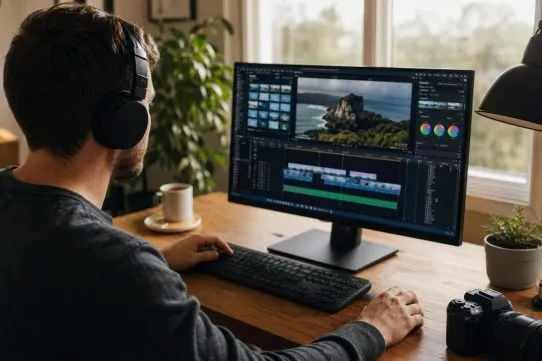
“Music for courses” refers to any audio track, whether background music, intro/outro music, transition cues, or ambient sound, that’s used inside an online course, tutorial, or e-learning product. It covers video lessons, screencasts, slide presentations, and even the promotional trailers you use to sell the course.
This is a term you’ll encounter as a course creator the moment you try to make your content sound more polished. And it comes with a licensing question that most creators ignore until it’s too late.
Who is this for? If you’re building video-based courses on any platform and wondering what music you can legally use, this is your starting point.
Need music that’s cleared for paid courses?
Learn how a one-time Extended license covers Udemy, Teachable, Kajabi, and every other major platform.
See Plans
A well-chosen track transforms a flat screen recording into something that actually holds attention. Here’s why so many instructors add music:
Professional polish. A clean intro with a short musical signature makes your course feel like a real product, not a bedroom recording.
Emotional cues. Music sets the tone for each lesson. A calm ambient track under a meditation module works differently than an upbeat loop in a marketing tutorial.
Brand identity. Students start associating your intro music with your teaching, the same way podcast listeners recognize their favorite show in two seconds. If you’re thinking about building a recognizable audio brand, understanding brand identity basics helps.
Transitions. Short stings between modules act like chapter breaks, giving the learner’s brain a moment to reset.
Here’s where it gets nuanced. Research from the e-learning community suggests that background audio can actually hurt learning if used carelessly. Background music competes with narration for the learner’s working memory. Adding too much auditory information at once can overload the brain’s processing capacity, reducing how well students recall what you taught them.
Practitioners in the Articulate e-learning community put it bluntly: you need to ask whether the audio you’re using will add to or detract from the learning objectives. Some people add background music because they know the course content is boring on its own. That’s not a music problem. That’s a content problem.
The takeaway: music for courses should be intentional, not decorative. Use it where it serves a purpose (intros, transitions, promo videos) and keep it low or absent during dense instructional segments.
Not all course music serves the same function. Here are the four main types you’ll encounter:
Intro/outro music. The audio signature that opens and closes each lesson or module. Usually 5 to 15 seconds. This is what students remember.
Background underscore. Low-key ambient music that plays softly under narration or screen recordings. Works best when it has no strong melody competing with your voice. A composer on TunePocket advises choosing music without a strong lead melody, especially for instructional content with spoken narration.
Transition stings. Short musical cues (2 to 5 seconds) between lessons or sections. They signal “we’re moving on” without you having to say it.
Promotional music. Used in course trailers, social media ads, and landing page videos. This music is typically more energetic because you’re selling, not teaching.
For a broader look at how background music for videos works across different formats, that guide covers the fundamentals.
This is where most course creators get into trouble. The assumption goes something like this: “I’m using 30 seconds of a song in an educational product, so fair use covers me.” It doesn’t.
“Educational use” under copyright law typically means content associated with an accredited learning institution, not for-profit learning materials sold through self-publishing platforms. A URI LibGuide on fair use for sound recordings makes the distinction clear: a self-teaching program or commercial course sold on Udemy does not qualify.
The major course platforms have put this in writing:
Udemy states that instructors should only post content that does not infringe on the intellectual property of others, including music and video snippets they are not authorized to use.
Thinkific goes further, explicitly recommending that creators “not add any copyrighted music to your course or site” to prevent copyright infringement.
These aren’t suggestions. They’re rules that can get your course removed.
If your course is available worldwide (and most platform-hosted courses are), you need worldwide copyright clearance. A license that only covers the U.S. or Europe won’t protect you when a student in Japan or Brazil accesses the content.
DMCA takedown notices can pull individual lessons or entire courses offline without warning. On Udemy, repeated violations can lead to account termination. Beyond platform consequences, the copyright holder can pursue statutory damages, which range from $750 to $30,000 per infringement under U.S. law, and up to $150,000 for willful infringement.
One instructor in the Udemy community posted: “I’m planning to add a very light background music to my Promo video. Any suggestions on how to find copyright-free music for commercial use?” This kind of question appears constantly in course creator forums. Even experienced instructors are unsure where to source music for courses legally.
A music teacher on Quora shared a related experience: they wanted to include a song in a book for students and contacted the publishing rights holder. The cost was $330 AUD for just 150 copies, back in 2011. Traditional licensing is expensive and impractical for digital course creators who might have thousands of students.
Need music that’s cleared for paid courses?
Using unlicensed tracks in a commercial course is a legal and financial risk. Learn how a one-time Extended license covers Udemy, Teachable, Kajabi, and every other major platform.
View Licensing Options
When sourcing music for courses, you’ll encounter four main license categories. Each one works differently, and picking the wrong one can leave you exposed.
Royalty-free music is available for commercial purposes. You pay once and can use the track in commercial projects without paying royalties each time the music is played. This is the most common model for course creators. But “royalty-free” doesn’t mean “free.” It means no ongoing royalty payments after the initial purchase.
Important: not all royalty-free licenses cover embedding music inside a paid product like a course. You often need an extended or commercial-plus tier. For a complete breakdown, see this guide on types of music licenses.
Free to use, but the restrictions vary widely. Many Creative Commons licenses exclude commercial use entirely. Others require attribution. Some prohibit modifications. You need to read the specific license attached to each track. Using a CC-NonCommercial track in a paid course is infringement, full stop.
This is typically what course creators actually need. An extended license explicitly covers embedding music in a paid product distributed to customers. Without this tier, even a standard commercial license may not cover a course sold on Teachable or Kajabi.
If you’re weighing ongoing subscriptions against a single purchase, the comparison of one-time payment licensing versus subscription plans breaks down the real cost differences.
No copyright. Free for any use, forever. The catch: genuinely public domain music is mostly very old (pre-1928 compositions), and specific recordings of those compositions may still be copyrighted. A public domain song performed by a modern orchestra is not free to use. You’d need a recording that’s also in the public domain.
Three practical guidelines that will save you time and legal headaches:
1. Skip strong melodies under narration. If your track has a catchy hook or prominent vocals, it will compete with your teaching voice. Choose ambient, textural, or rhythmic tracks that sit underneath speech without pulling attention away.
2. Match energy to subject matter. A yoga course calls for slow, spacious ambient music. A business strategy course might benefit from a light, confident corporate track. An art course could use something more creative and eclectic. The music should feel like a natural extension of the topic.
3. Verify the license before you embed. Read the actual license terms, not just the marketing page. Confirm that the license covers:
Commercial use (your course is a paid product)
Embedding in a distributed product (not just background in a YouTube video)
Worldwide distribution (your course is accessible globally)
Perpetual use (you don’t want to relicense every year)
For platform-specific licensing guidance covering Skillshare, Udemy, Kajabi, and Teachable, this walkthrough on music licensing for course platforms covers the details.
The online learning market reached $203.81 billion in 2025, projected to hit $279 billion by 2029 at an 8.2% compound annual growth rate. The e-learning subscription market alone is expected to reach $50 billion by 2026.
That means millions of new course videos are being produced every year. Beyond traditional education, independent educators, coaches, and businesses are building courses to train employees, establish authority, and generate revenue. Each of those courses potentially needs licensed music.
If you’re researching platforms to host your course, a comparison of the best online course platforms for creators can help you decide where to publish.
The scale of the market also means copyright holders are paying more attention. Automated content scanning (like YouTube’s Content ID) catches unlicensed music use with increasing accuracy, and platforms are building similar detection tools. The window for “nobody will notice” is closing fast.
No. Spotify’s terms of service explicitly prohibit using streamed music in any external product. Spotify licenses are for personal listening only. Using a Spotify track in a course is copyright infringement regardless of whether you have a premium subscription.
Almost never. Fair use in U.S. copyright law is evaluated on four factors, and commercial use in a for-profit course weighs heavily against you. “Educational use” under fair use typically refers to accredited institutions, not self-published courses on commercial platforms.
You need a license that explicitly covers embedding music in a paid, distributed product. A standard royalty-free license often isn’t enough. Look for an “extended” or “commercial-plus” tier that names course platforms or paid products as covered use cases. The license should grant worldwide, perpetual rights. Foximusic’s Extended license, for example, is specifically designed for this use case, covering courses on Teachable, Kajabi, Udemy, and similar platforms with a one-time payment and lifetime rights. For a deeper look at how this works, the comprehensive guide to music licensing for content creators explains the tiers in detail.
It depends on the specific track’s license. Many YouTube Audio Library tracks are licensed only for use in YouTube videos, not for embedding in external paid products. Check each track’s license terms carefully. If the license says “YouTube only” or doesn’t mention commercial distribution, it won’t cover your course.
The copyright holder can file a DMCA takedown notice, which forces the platform to remove the infringing content. On Udemy, repeated violations can result in account termination. Beyond platform consequences, you could face statutory damages ranging from $750 to $150,000 per infringement under U.S. law.
Royalty-free means you pay once and owe no ongoing royalties for continued use. The music is still copyrighted, and you still need a license. Copyright-free (public domain) means no copyright exists on the work at all. Most music marketed as “royalty-free” is copyrighted and licensed, not free of copyright. Confusing these two terms is one of the most common mistakes course creators make.
This depends entirely on the license terms. Some licenses cover a single project (one course). Others cover unlimited projects. Read the license agreement carefully. If you’re creating multiple courses, look for a license that either covers unlimited projects or buy a separate license for each course.
One license. Every course platform. Forever.
Foximusic’s Extended license covers Kajabi, Teachable, Udemy, and any paid learning platform with a single, one-time payment and lifetime rights. No renewals, no recurring fees, no surprises.
See Plans
Generate production-ready text-to-video prompts instantly and get pro-level results with our free video prompt generator tool.







 English English
  Spanish
 French
 Italian
 German
 Portuguese
 Chinese
 Japanese
 Hebrew