✨ 使用人工智能总结文章

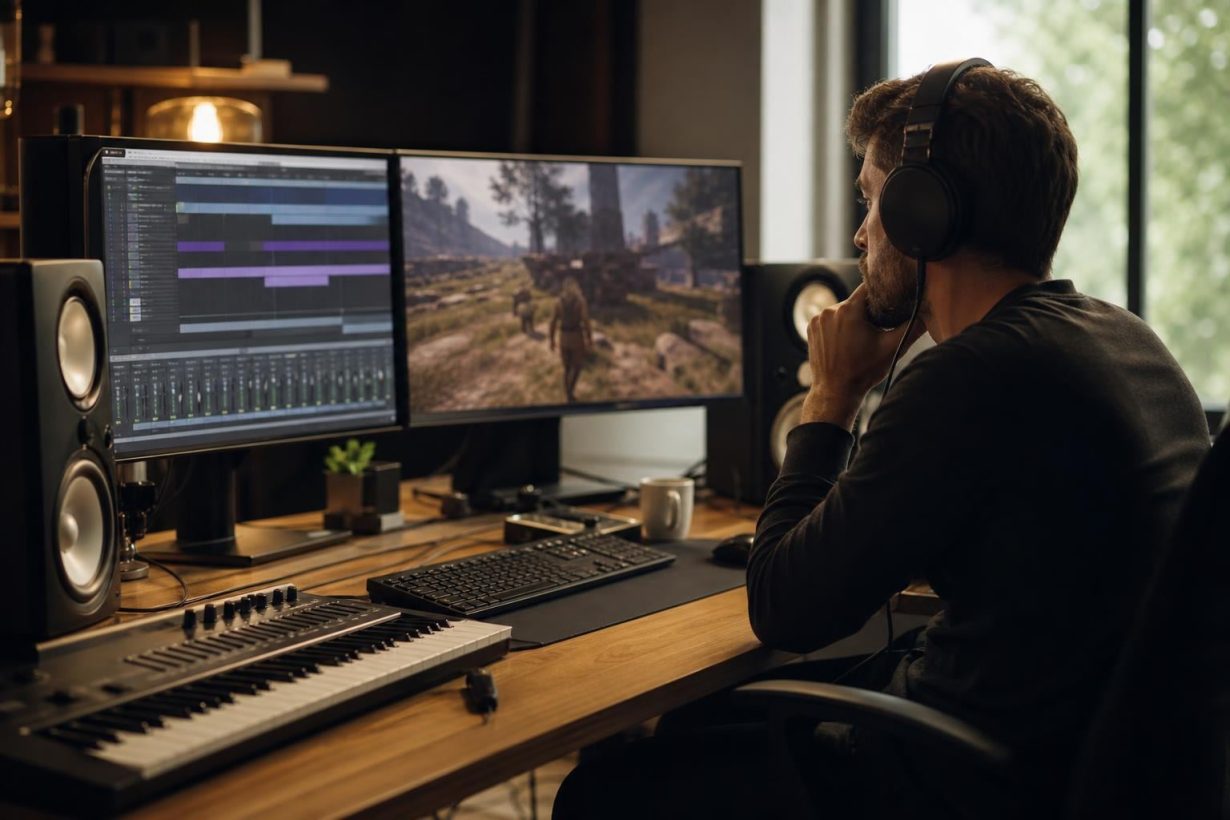
Music licensing for video games involves two separate copyrights (composition and recording), each requiring its own license. Royalty-free doesn’t mean free, it means no ongoing royalties after a one-time payment. If streamers play your game and the music isn’t cleared for streaming, they’ll get DMCA strikes, and some will stop playing your game entirely. This glossary breaks down every licensing term you’ll encounter while building your soundtrack.
You’re building a game. You need music. You Google “music licensing for video games” and immediately hit a wall of terms: sync licenses, master use licenses, PROs, Content ID, blanket licenses, buyouts. None of it is written for someone who just wants to ship a game without getting sued.
This glossary exists so you can bookmark it, reference it during development, and make licensing decisions without a law degree.
If you want to skip the jargon and start browsing game-ready tracks with lifetime licenses, Foximusic 的目录 is a practical starting point.
Getting music licensing wrong has real financial consequences. Statutory damages for copyright infringement range from $750 to $30,000 per infringed work, and up to 每项工作 $150,000 if the infringement is willful. According to industry analysis, roughly 15% of indie titles face copyright claims after launch.
The financial risk is only half the story. A content creator on itch.io put it bluntly: “I’m soooo bummed to find out that the music that plays throughout the entire demo gets copyright claimed. And it’s in a way that will be very hard to edit out. Something like that will stop me from buying the full version.” Music licensing doesn’t just protect you legally. It directly affects whether streamers will promote your game for free, which for most indie studios is the primary marketing channel.
A sync license grants permission to use a copyrighted musical composition alongside visual media. In gaming, this covers using a song’s melody, lyrics, and arrangement in your game.
The key detail most developers miss: a sync license only covers the composition itself, not the actual audio recording. If you want to use a specific recording of a song, you need a separate license for that too. For a deeper breakdown, see this guide on 音乐版权许可类型.
A master use license covers the actual recorded audio file, the specific performance captured in the studio. Any use of a protected recording in a video game, whether it’s a full song or a three-second sample, requires one.
Why you need both: Every piece of recorded music carries two copyrights. The composition (what was written) and the master recording (what was recorded). Using a track in your game without both a sync license and a master use license is infringement, even if you paid for one of the two. This dual-copyright structure is the single biggest source of confusion in music licensing for video games.
Royalty-free does not mean free. It means you pay a one-time license fee and then owe no ongoing royalties based on sales, downloads, or plays. You still pay upfront for the license itself.
The major advantage for game developers: royalty-free music libraries typically bundle both the composition and recording rights into a single license. No separate sync and master use negotiations. No back-and-forth with publishers. One transaction, one license. For more on what royalty-free actually covers in commercial projects, this breakdown of 无需支付版税的歌曲 clarifies common misconceptions.
An exclusive license means you alone have the right to use a piece of music. No other game, film, or advertisement will feature that track. The price reflects this exclusivity, and for well-known compositions, the cost can run into six figures.
For most indie developers, exclusive licenses are unnecessary. Unless your game’s identity is built around a specific licensed track (think Tony Hawk’s Pro Skater), the premium isn’t justified.
A non-exclusive license is significantly cheaper than its exclusive counterpart. The tradeoff is that another game might share your menu music. For background tracks, ambient loops, and battle themes, this is a reasonable compromise. Most royalty-free platforms operate on non-exclusive terms.
A perpetual license means the rights don’t expire. You pay once, and the music stays in your game forever, through updates, ports, remasters, and re-releases. No renewals, no recurring fees.
Perpetual licenses are difficult and expensive to negotiate through traditional channels, especially for indie teams working directly with publishers and labels. This is one area where royalty-free platforms offer a clear advantage: perpetual terms are often the default. To compare how 一次性购买许可证 stacks up against subscriptions, that distinction matters a lot for long-lived game projects.
A blanket license gives you access to an entire catalog (or a defined portion of it) for a flat fee. Radio stations commonly use blanket licenses from PROs. In gaming, blanket-style arrangements are less common but do exist through some royalty-free platforms that offer bundle pricing across multiple tracks.
A rights-managed license ties usage rights to specific parameters: territory, duration, platform, audience size, and media type. If your game launches on Steam in North America, then later expands to consoles worldwide, you may need to renegotiate. Rights-managed licenses offer precision but add complexity that most indie developers don’t want.
This is the foundation of everything in music licensing for video games. A song has two separate copyrights:
These two copyrights can be (and often are) owned by different people or entities. That’s why licensing a single track can mean negotiating with two separate parties.
PROs like ASCAP, BMI, and SESAC track public performances of music and collect royalties on behalf of songwriters and publishers. They cover venues, retail stores, broadcast, and streaming.
Here’s where it gets complicated for games. The normal act of a user purchasing and playing a video game typically doesn’t generate performance royalties for the composer. But if that game is streamed on Twitch or YouTube, the platform may owe performance royalties. This gray area creates friction. Composers working on games should ensure their upfront fee reflects the full value of their work, because that upfront payment is likely all the money they’ll receive from the game itself.
PRO-free music means neither the composition nor the recording is registered with any performing rights organization. No cue sheets to file, no split negotiations, no platform conflicts.
For developers shipping games that will be streamed (which is most games today), PRO-free music eliminates an entire category of legal complexity. No streamer needs to worry about whether a platform has a blanket PRO license. For more on why this matters for broadcast and streaming contexts, see this explanation of PRO-free music for broadcast.
YouTube’s automated fingerprinting system that scans uploaded videos against a database of registered audio. When it finds a match, it can flag, mute, or redirect ad revenue from the video.
This matters enormously for game developers because even properly licensed music can trigger Content ID claims against streamers and YouTubers playing your game. One indie developer shared on itch.io forums: “Even though it was royalty free, YouTube’s Content ID system flagged my trailer for the game so last minute we ditched the music.” Another developer reported that all their AudioJungle-sourced music was getting flagged on YouTube but not on Twitch, likely a false-positive bug in YouTube’s system. For a full explanation of how the system works, this Content ID and AdRev guide 涵盖了机制方面的内容。.
The DMCA gives copyright holders the power to issue takedown notices against content that uses their work without authorization. On platforms like Twitch and YouTube, DMCA strikes can result in deleted videos, muted streams, or banned accounts.
The critical nuance for game developers: music licensed for inclusion in a video game does not automatically grant streaming rights. A streamer playing your game can still receive a DMCA strike if the music license doesn’t explicitly cover that use case. For a thorough look at how this plays out, Twitch music licensing covers the streamer side in detail.
Under a work-for-hire agreement, a composer creates music specifically for your game, and the copyrights for both the composition and the recording belong to you (the developer or publisher). The music is legally no different from your game’s art or code.
Work-for-hire is the cleanest arrangement from a rights perspective. You own everything. No licensing ambiguity, no streaming complications. The downside is cost: you’re paying for original composition, recording, and full rights transfer. For indie teams with tight budgets, this path is often unrealistic for a full soundtrack.
Adaptive music changes in real time based on gameplay. Think of how the soundtrack in Red Dead Redemption 2 shifts with the action, or how combat music layers in intensity as threats increase. Instead of playing static tracks, the game triggers different stems, loops, and transitions dynamically.
This creates specific licensing challenges. You’re not licensing a single finished track. You may need rights for individual stems, loops, and interactive elements that get recombined during gameplay. If you’re using library music for adaptive purposes, confirm that your license covers editing, remixing, and layering the track into separate components.
Diegetic music exists within the game world. The characters can “hear” it. Think of the car radio in Grand Theft Auto or a jukebox in a bar scene. Non-diegetic music is the underscore that only the player hears: menu themes, battle music, ambient exploration tracks.
This distinction matters for music licensing for video games because diegetic use of recognizable, commercially released songs carries higher streamer risk. When a famous song plays from an in-game radio, Content ID systems are more likely to flag it than they would an original underscore. It’s also more expensive to license, since diegetic use of well-known tracks is a premium placement.
A toggle in the game’s settings that replaces or mutes licensed music tracks that could trigger DMCA claims for streamers. CD Projekt RED pioneered this approach with Cyberpunk 2077, where enabling Streamer Mode disabled specific tracks that could cause issues, replacing them with different songs.
Practitioners on Steam community forums explain why this exists: “Where streamers usually get DMCA’d is when a game has music that was written separately by a third party and then later licensed for use in the game. Those licenses often do not provide for streaming permission.”
Building a Streamer Mode requires significant development effort. The simpler path: choose music that’s pre-cleared for streaming from the start, so you never need the toggle at all.
茎 are individual instrument tracks (drums, bass, melody, pads) that can be mixed independently. Loops are sections of music designed to repeat seamlessly. Edits are shortened or restructured versions of a full track (30-second versions, intro-only cuts, etc.).
Game developers use these more than any other creative industry. Stems enable adaptive music systems. Loops power exploration and idle states. Short edits work for menus, loading screens, and cutscenes. When licensing music for a game, check whether your license includes these variants or only the full mix.
If you’re building a game and want music pre-cleared for streaming, with multiple versions per track included, 浏览 Foximusic 的产品目录 for lifetime-licensed, PRO-free, Content ID-cleared tracks.
Paying individually for each track you use. This is the standard model for most royalty-free platforms and traditional licensing deals. Costs vary dramatically based on exclusivity, usage scope, and the track’s origin.
Purchasing multiple tracks together at a discounted per-track rate. For game developers who need 10 or more tracks for a full soundtrack, bundles significantly reduce costs. Most royalty-free platforms offer tiered bundle pricing. Understanding how music licensing fees work at different tiers helps with budget planning.
A buyout is a one-time payment that transfers full usage rights (and sometimes ownership) to the buyer. In the context of royalty-free music, “buyout” often refers to a perpetual, royalty-free license rather than a true copyright transfer. In work-for-hire arrangements, buyout means you own the copyright outright. The term gets used loosely, so always read the specific license agreement.
| Licensing Path | Typical Cost | 最适合 |
|---|---|---|
| Traditional licensing (sync + master) | $500 – $2,000 per track (indie); much higher for AAA | Games using commercially released songs |
| Custom composer | $50 – $2,500 per minute; typical indie budget $1,000 – $10,000 total | Original score, adaptive music, work-for-hire |
| Royalty-free platforms | $12 – $150 per track depending on tier and use case | Most indie games, trailers, game jams |
The decision between library music and custom scoring comes down to budget and timeline. If your total audio budget is under $5,000, custom composition for a full soundtrack is unrealistic. Royalty-free library music gives you professional quality at a fraction of the cost. For a comparison of 一次性付款 vs. 订阅 models, that breakdown helps with long-term cost planning.
This section connects the glossary terms above to the single biggest practical concern in music licensing for video games today: what happens when someone streams your game.
A sync license for your game does not equal streaming clearance. When a Twitch streamer broadcasts your game, the music is being publicly performed and recorded simultaneously. YouTube’s Content ID system can flag the streamer’s video, mute the audio, or redirect ad revenue. Twitch’s DMCA enforcement can issue strikes against the streamer’s channel.
Studios have found workarounds. CD Projekt RED built a Streamer Mode into Cyberpunk 2077. Riot Games released an entire album specifically for content creators to use without DMCA risk. Both approaches work, but both represent significant effort.
The simpler path is choosing music that’s pre-cleared for streaming from the beginning. PRO-free, Content ID-cleared music eliminates the entire problem. No cue sheets. No Content ID flags. No DMCA risk for your biggest unpaid marketing channel. For more on how this works in practice for creators, this guide on 面向内容创作者的音乐授权 covers the streamer perspective.
In March 2026, PRS for Music (the UK’s performing rights organization) filed legal proceedings against Valve, the company behind Steam. The claim: since its launch in 2003, Valve has never obtained a license for music rights managed by PRS on behalf of songwriters, composers, and music publishers.
The lawsuit centers on whether Valve, as the supplier of games under the UK’s Copyright, Designs, and Patents Act 1988, needs its own music license on top of whatever licenses individual game developers hold. PRS has previously reached agreements with Sony Computer Entertainment Europe for similar use of protected music in games, suggesting this isn’t an unprecedented demand.
This case could reshape how distribution platforms handle music rights across the entire industry. For indie developers, it’s a reminder that music licensing for video games isn’t just your problem. It’s a structural issue that reaches up the entire distribution chain.
Not sure which licensing path fits your project? Use these guidelines.
No. Royalty-free means you pay a one-time license fee and owe no ongoing royalties based on sales or usage. You still pay upfront for the license. The “free” refers to freedom from recurring royalty payments, not the price.
Yes. A license that allows you to include music in your game does not automatically grant streaming rights. Practitioners on Steam forums confirm that streamers most commonly get struck when a game uses third-party music licensed separately, where the license doesn’t cover streaming.
A sync license covers the composition (the written song). A master use license covers the recording (the actual audio file). These are two separate copyrights, often owned by different parties. You need both to legally use a commercially recorded song in your game.
Traditional licensing runs $500 to $2,000 per track for indie games, with AAA budgets going much higher. Custom composers charge $50 to $2,500 per minute. Royalty-free platforms range from about $12 to $150 per track depending on the license tier and use case.
PRO-free music isn’t registered with any performing rights organization (ASCAP, BMI, SESAC). This eliminates complications around public performance royalties, cue sheets, and platform licensing conflicts. For games that will be streamed, PRO-free music removes an entire layer of legal complexity.
The lawsuit targets Valve as a distribution platform, not individual developers. But the outcome could set precedents for how music royalties are collected on digital storefronts globally. It’s worth monitoring, especially if your game uses music registered with a PRO.
Under work-for-hire, a composer creates music for your game and you own both copyrights (composition and recording). It’s the cleanest arrangement from a legal standpoint but typically the most expensive option, making it impractical for full soundtracks on tight indie budgets.
Often, yes. Many music licenses specify the medium of use. A license that covers in-game use may not cover a YouTube trailer or a Steam store page video. Always check whether your license explicitly includes promotional materials, or license trailer music separately.
Looking for game-ready music you can license once and ship forever, without worrying about DMCA strikes or PRO complications? Start with Foximusic的播放列表 to find tracks by mood and genre.
使用我们免费的视频提示生成器工具,即可立即生成可用于生产的文本转视频提示,并获得专业级的效果。.








 English English
  Spanish
 French
 Italian
 German
 Portuguese
 Chinese
 Japanese
 Hebrew