✨ Summarize article with AI

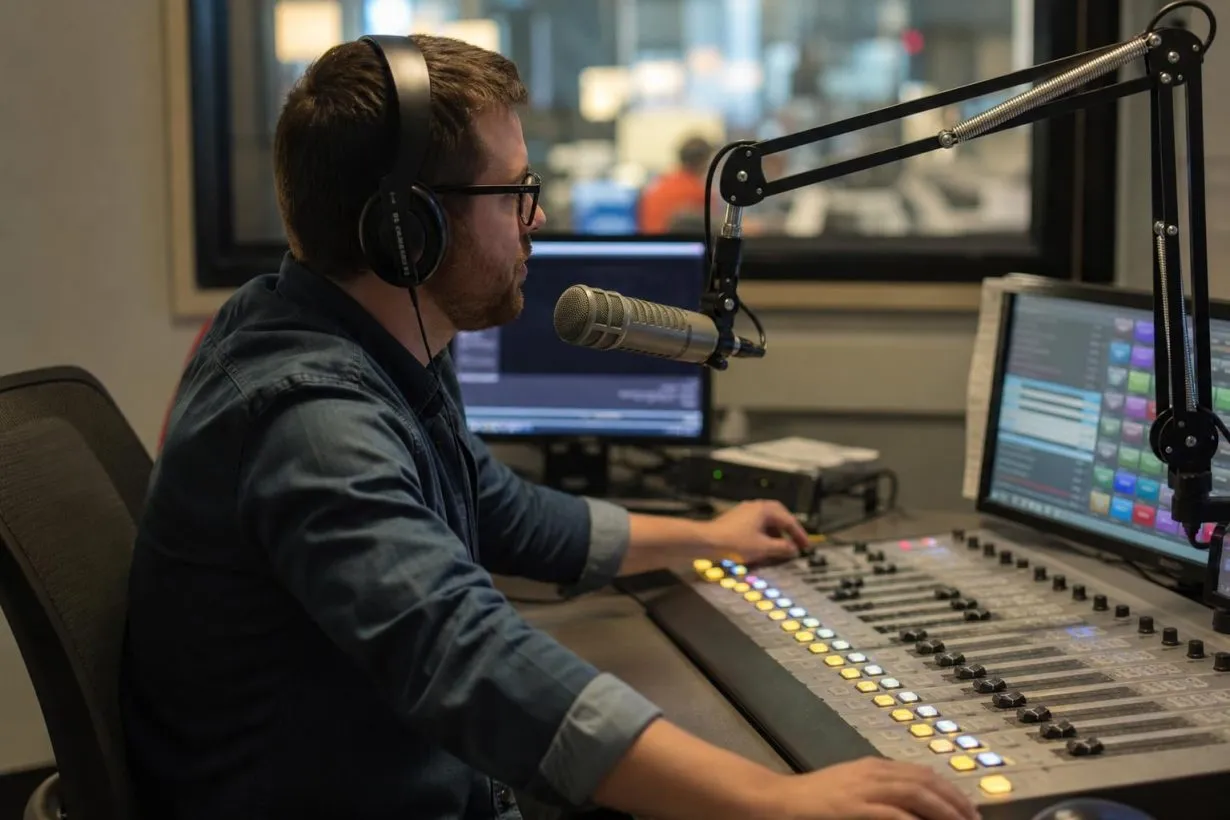
A broadcast music license is permission to use music in content transmitted to the public, like TV, radio, internet radio, or streaming platforms. There is no single “broadcast music license” that covers everything. Radio stations, TV producers, internet streamers, and video editors all need different rights depending on how the music is used. Before choosing a track, confirm whether your license covers the specific broadcast format, territory, and duration your project requires.
Your client says, “We might run this video on TV later,” and suddenly a normal online music license may not be enough. Broadcast music licensing gets confusing because radio, TV, streaming, ads, and VOD each involve different rights. This guide explains what a broadcast music license actually means, what it covers, and what to check before you lock the edit.
A broadcast music license is legal permission to use music in content that gets transmitted or distributed to the public. That includes radio airplay, television programming, internet radio streams, TV commercials, promos, and streaming channels.
Here is what trips people up: “broadcast music license” is not a single document you buy once and forget. It is a category that can include public performance rights, synchronization rights, master-use rights, or digital transmission rights, depending on what you are doing with the music.
The U.S. Copyright Office explains that a recorded song involves two separate copyrighted works: the musical composition (melody, lyrics, arrangement) and the sound recording (the specific recorded performance). Different broadcast uses touch different combinations of these rights.
Think of it this way: a radio station playing songs to the public is doing something legally different from a video producer editing music under a TV commercial. Both are “broadcasting,” but the permissions they need are not identical.
If you are working on projects that could move from online to TV or radio, it helps to understand how music licensing tiers work before the final cut, not after.
It depends entirely on the license. A broadcast music license might cover the public performance of a song, the use of a specific recording, the synchronization of music with video, or a bundle of those rights. The table below breaks down the most common situations.
| Question to ask | Why it matters | Right involved |
|---|---|---|
| Are you playing music to the public? | Radio, TV, live streams, and digital transmissions count as public use | Public performance license |
| Are you putting music under video? | TV ads, promos, films, OTT content, and social ads pair music with visuals | Synchronization license |
| Are you using a specific recorded track? | The recording is a separate copyright from the composition | Master use license |
| Is it internet radio or simulcast? | Digital audio transmission often adds sound-recording royalties | SoundExchange/statutory or direct license |
| Is it on-demand? | Podcasts, VOD, and interactive uses often fall outside radio-style statutory licenses | Direct sync, master, or mechanical rights |
For a deeper breakdown of each license type, see this overview of the seven types of music licenses that creators commonly encounter.
The Copyright Alliance confirms that music permissions can involve several layers: public performance licenses from PROs, synchronization licenses for pairing a composition with video or film, and master-use licenses for a specific sound recording.
Always check the allowed media, territory, term, audience size, and platforms before assuming a license covers broadcast use.
A public performance license covers playing or transmitting music to the public. In broadcast contexts, this is the license that radio stations, TV stations, digital services, venues, and other public-facing businesses need for the musical composition.
In the U.S., performing rights organizations (PROs) like BMI, ASCAP, SESAC, and GMR license public performance rights for musical works. BMI states that public performance includes transmission via radio, TV broadcasts, and digital service providers. But here is the critical part that many creators miss: BMI also states it only licenses performing rights, not mechanical or synchronization rights.
What does that mean practically? A TV station’s PRO license may let it air programs containing music. But it does not give a video producer the right to edit a popular song into a commercial. The station’s license covers the broadcast. The producer still needs separate permission to put the music into the content in the first place.
This distinction matters most for freelance editors and agencies. Your client’s broadcaster might have performance licensing sorted out, but that does not replace your obligation to use music you are legally allowed to embed in the deliverable.
A sync license is needed when music is paired with moving images. If you use music in a TV commercial, show intro, documentary, YouTube ad, streaming video, or VOD program, you are dealing with synchronization rights.
“Sync” means the music is synchronized to picture. This is a separate right from performing the finished program. The Television Music License Committee (TVMLC) puts it plainly: when music is used in video production (a segment, advertisement, or news piece), synchronization rights need to be cleared. Performance rights then cover broadcasting the finished content.
For a practical understanding of how sync licensing works, this sync license explainer covers the basics.
Here is a real-world scenario. A local car dealer hires a videographer for a 30-second holiday TV ad. The producer needs music that allows use in the commercial itself. The TV station may have its own performance licensing for airing the spot, but that does not replace the producer’s need to clear the music for the ad file delivered to the station.
Production attorneys on Reddit’s r/Filmmakers have spelled out the same issue: if a film or TV project uses a pre-existing recording, the producer generally needs sync rights for the composition and master-use rights for the recording. Costs for a single popular song in one scene can range from nothing (in rare indie situations) to tens of thousands of dollars.
This is why production music and royalty-free libraries exist. They offer a simpler clearance path for creators who cannot afford to negotiate directly with major publishers and labels.
A master use license covers the specific recording you want to use. The composition (melody, lyrics) and the master recording (the specific performance captured in studio) are two separate copyrights, often owned by different parties.
If you want to use a famous artist’s released version of a song, you typically need permission from both the publisher (for the composition) and the label (for the recording). Using a cover version avoids the original master owner, but it does not avoid the composition or sync clearance.
One-stop music libraries are valuable precisely because one party controls both the composition and the recording. That simplifies the broadcast music license process significantly, especially for time-sensitive campaigns.
Interested in what broadcast-ready music actually costs? This guide covers music licensing costs for commercials across different use cases.
The answer depends on how and where the music will be heard. Here is a quick reference:
| Use case | Likely licensing need | Notes |
|---|---|---|
| FM/AM radio station playing songs | PRO performance license or direct license | Adding online simulcast requires more rights |
| Internet radio | PRO license for compositions + SoundExchange or direct license for recordings | Noninteractive vs interactive rules matter |
| TV commercial | Sync + master + performance | Use broadcast-cleared music from the start |
| TV show, promo, or news segment | Sync + master + cue sheet for performance reporting | Station and network rules apply |
| Podcast or on-demand show | Direct rights, often sync, master, and mechanical | Not covered by radio-style statutory licenses |
| App or video game | License must explicitly allow app/game distribution | Check the game licensing guide |
| Social video only | Online commercial license may be enough | Check monetization and Content ID coverage |
| Social video later used on TV | Broadcast tier needed | Decide before client approval |
The last row is where most creators get burned. A marketing agency edits a client video for Instagram and YouTube. Three months later, the client wants to run the same video on regional TV and a streaming ad platform. The original license might only cover online and social use.
Practitioners on Reddit’s r/videography describe this exact pain point: a client starts with social media use, then pushes the deliverable to broadcast or a livestreamed event, changing the licensing requirements entirely. The editor has to replace the music, re-export, re-approve, and possibly miss the media buy window.
The fix is simple but requires planning. If there is any chance the content will air on TV, radio, OTT, VOD, or apps, pick broadcast-cleared music before you lock the edit.
Browse music for video ads that is cleared for commercial use from the start.
Yes. In the U.S., federal copyright law requires radio stations to obtain permission before publicly performing music. Stations do not negotiate with every songwriter for every spin. Instead, they typically use blanket or per-program licenses from PROs.
A blanket license covers the PRO’s repertoire, but not necessarily every song in the world. Multiple PROs may be needed because each one represents different works. BMI says commercial radio licensing fees are often based on a percentage of gross broadcast and new-media revenues.
The top-ranking Reddit ELI5 thread for this keyword captures the beginner question perfectly: “Do radio stations license every song individually, or do they buy a huge license?” The most helpful community answer is that stations use broad catalog licenses and reporting systems rather than clearing each song one by one.
If a station also streams online, things change. Simulcasting and internet streaming can trigger additional digital rights and reporting obligations, particularly around sound recordings.
For a deeper look at internet radio specifically, this internet radio licensing guide breaks down the requirements.
Usually, yes. Internet radio and simulcast streaming can require licenses for both the musical work and the sound recording. In the U.S., a noninteractive stream may use PRO licenses for compositions and SoundExchange statutory licensing for sound recordings. But interactive or on-demand services need direct licenses from copyright holders.
SoundExchange explains that sections 112 and 114 of the Copyright Act cover eligible noninteractive digital audio services, the kind that function like traditional radio. The statutory license does not apply to interactive or on-demand services. Those require direct negotiation.
The rates are public and updated regularly. For 2026, commercial webcasters pay $0.0025 per nonsubscription performance, with a $1,000 annual minimum per channel. Commercial broadcasters making nonsubscription digital audio transmissions pay $0.0028 per performance with a $1,100 minimum per station.
These numbers matter because they add up fast. A station playing 15 songs per hour, 24 hours a day, to even a modest audience generates millions of performances per year. That is why many hobby stations and small operations look to royalty-free or PRO-free music as a way to control costs.
No. Buying or streaming a song for personal listening does not give you public broadcast, commercial, sync, or master-use rights. A digital music subscription gives access to a catalog for personal enjoyment. It does not provide copyright clearance to play those songs in a public or commercial setting.
A recent r/radio thread about college radio includes the practical warning that buying a CD or download does not come with a license for airplay. This is one of the most common mistakes new broadcasters make.
The RadioCult internet radio guide (updated July 2026) says the same thing plainly: owning a track, download, CD, or vinyl does not give the right to broadcast it.
Before using music in broadcast content, work through this checklist. Keep the answers documented alongside your project files.
Broadcast music license checklist:
A sync agent on Reddit’s r/advertising recommends clearing songs early, keeping backups, and using one-stop music when speed matters. The reasoning is practical: editors need music that is ready before the cut is locked, not after the client has approved the final video.
A recent LinkedIn post from Downtown Music reinforced the same idea, noting that clear metadata and ownership information can matter as much as creativity for sync placements. Unclear ownership slows down approvals and increases risk.
For more on Content ID and how it affects your monetization, that explainer covers the YouTube side of things.
No. An FCC broadcast license gives a station permission to use radio frequency spectrum. A broadcast music license gives permission to use copyrighted music. A station may need both, but they solve completely different problems. Internet-only radio may not need an FCC spectrum license at all, but it still needs music licenses if it streams copyrighted content.
Under 17 U.S.C. Section 504, statutory damages range from $750 to $30,000 per infringed work. Willful infringement can push that ceiling to $150,000 per work. Beyond the legal risk, unlicensed music in a broadcast deliverable can result in pulled ads, killed campaigns, and damaged client relationships.
Documentation is your insurance. Keep the license certificate, invoice, and track metadata with every project file.
Most broadcast music licensing confusion comes down to one question: does your license actually cover the way the content will be distributed?
“Royalty-free” describes a payment model, not a blanket permission for every use. Many royalty-free licenses cover online and social media but restrict TV, radio, apps, games, VOD, paid ads, or large live performances. You still have to read the license tier.
Foximusic’s Extended tier is built specifically for projects that go beyond standard online use. According to the first-party license description, it covers TV/radio, VOD/streaming, apps/games, courses, film/festival use, and live audiences up to 20,000, all under a one-time payment with perpetual, worldwide rights. Extended pricing starts at $150 for a single track, with bundles bringing the per-track cost down (10 tracks for $1,000). Every licensed download includes uncompressed WAV files and an instant license certificate.
Because Foximusic owns 100% of its catalog, there are no third-party conflicts or changing terms to worry about. Tracks are Content ID-cleared, which means the same music works on YouTube, social platforms, and broadcast without triggering claims.
For a detailed comparison of one-time payment licensing versus subscriptions, that guide covers the cost math.
A broadcast music license is permission to use music in content transmitted to the public, including TV, radio, internet radio, streaming channels, commercials, promos, or broadcast programs. The exact rights needed depend on the format: playing music over radio is different from syncing it into a TV ad.
Not always. If the video stays on YouTube, you need a license that covers online video use and monetization. If the same video later runs on TV, radio, OTT, VOD, or paid broadcast media, you need a license that includes those rights. Plan for the widest possible use before locking the edit.
A PRO license covers public performance rights for the musical works in that PRO’s repertoire. It does not cover synchronization rights, master-use rights, or every song in existence. BMI explicitly states it licenses performing rights only.
You typically need permission to sync the music with the commercial and permission to use the specific recording. If you use royalty-free or production music, choose a license tier that explicitly allows TV or radio advertising.
Only if the license says broadcast use is included. “Royalty-free” means you do not pay recurring per-use royalties after licensing. It does not automatically grant TV, radio, app, or VOD rights.
A sync license gives you the right to pair music with moving images (creating the audio-visual work). A broadcast music license, in the performance sense, covers transmitting that finished work to the public. For TV and video production, you often need both.
Not in the traditional radio sense. Podcasts are typically on-demand and downloadable, which means they may require direct permissions including sync, master, and possibly mechanical rights. Radio-style statutory licenses generally do not cover on-demand availability. For more, see this guide to podsafe music for podcasts.
Some are, some are not. Always check the territory field. Some licenses cover one country, others cover worldwide use. The important thing is matching the license territory to where your content will actually be distributed.
This article is for informational purposes and does not constitute legal advice. Consult a qualified attorney for specific licensing questions.
If your client video might end up on TV, radio, VOD, an app, or a streaming platform, choose the music license before the final edit. Start by browsing Foximusic’s broadcast-ready catalog, test tracks with watermarked previews in your timeline, and keep the license certificate with your delivery files so the project is ready when the client asks, “Can we broadcast this too?”
Generate production-ready text-to-video prompts instantly and get pro-level results with our free video prompt generator tool.








 English English
  Spanish
 French
 Italian
 German
 Portuguese
 Chinese
 Japanese
 Hebrew